How to Summarize an Article: The Method That Works
Summary
To summarize an article accurately, you need two reads and one step most guides skip: a reverse outline built from what you actually read. Draft from that outline, with the article closed. This prevents copying and forces genuine comprehension. Keep qualifiers like "may" and "suggests" intact. Use AI tools to scaffold a first draft, then verify. How to summarize an article starts with knowing what the original actually claims, not what you expected it to say.

To summarize an article accurately, you need two reads and one step most guides skip: a reverse outline built from what you actually read. Draft from that outline, with the article closed. This prevents copying and forces genuine comprehension. Keep qualifiers like "may" and "suggests" intact. Use AI tools to scaffold a first draft, then verify. How to summarize an article starts with knowing what the original actually claims, not what you expected it to say.
The problem is not the length, it is the reading strategy
Most guides on how to summarize an article tell you to skim, find the thesis, note the main points, and write a condensed version. The advice is not wrong. It is just incomplete in the way that causes the most common failures: summaries that repeat the introduction, miss the actual argument, or paraphrase so closely they are a step away from copying.
The real problem is that most people read an article the same way regardless of what they plan to do with it. Reading to enjoy is different from reading to summarize. Reading to summarize requires tracking a specific kind of information: what the author claims, what evidence they use, what limits they acknowledge, and what they do not say.
The problem is not the article's length. The problem is reading without a method.
Two habits fix most of this. First, decide on your target length before you start reading. A one-sentence summary, a one-paragraph summary, and a one-page summary require you to notice completely different things. Choosing before you read shapes what you retain. Second, do not take notes in the margin as you go. Annotation tends to produce a second version of the article rather than a distillation of its logic.
Read twice, for two different things
The first read is for argument. What is this article actually claiming? Not what it is about (topic) but what position it takes (thesis). These are different. An article about climate adaptation can argue that current policy frameworks are insufficient, or that market mechanisms outperform regulation, or that local knowledge is systematically excluded. Same topic, three different claims.
On the first read, resist the urge to note details. Read the abstract, the introduction, and the conclusion first if this is an academic paper. Then read the body sections to understand the logic, not to catalogue the evidence.
The second read is for structure. Now you track: which claims are central and which are supporting, what kinds of evidence the author uses, and where they hedge. This is where you note limits, qualifiers, and counterarguments the author raises and addresses. These are exactly the elements that distinguish a precise summary from a vague one.
At the end of the second read, you should be able to answer four questions without looking at the text:
What does the article argue?
What are the two or three strongest pieces of evidence?
What does the author acknowledge as a limit or exception?
What is the practical implication, if any?
If you cannot answer these from memory, a third read is more useful than starting to write.
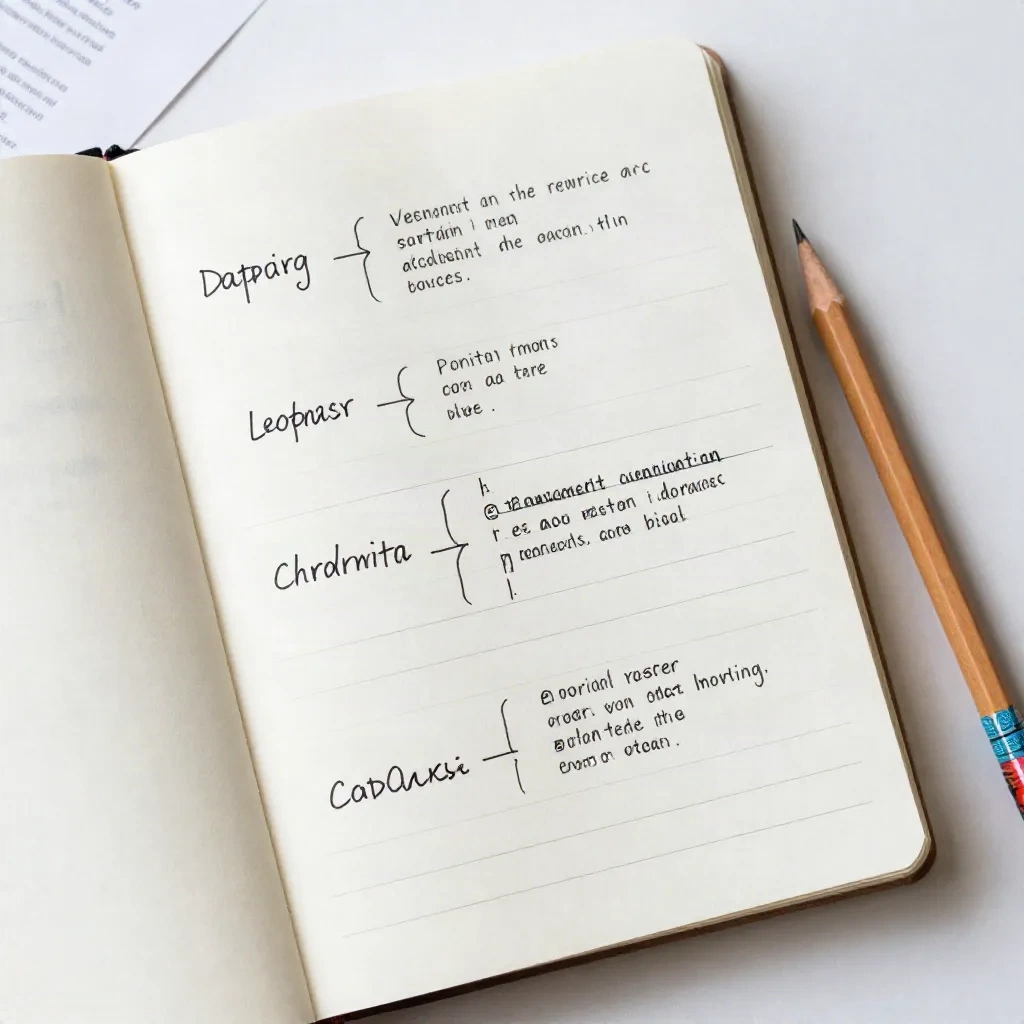
Build the reverse outline (after reading, not before)
A reverse outline is the step most summarization guides omit, and it accounts for most of the quality gap between adequate summaries and precise ones.
The process is simple: after your second read, list what the article actually says, section by section, in your own words. You are not outlining what you expected the article to say. You are recording what it says. One sentence per section is enough.
This serves two functions. It forces you to verify that you understood each section before drafting. And it exposes the real architecture of the argument, which often differs from the announced structure. An article may have five sections but only three logical moves.
When building the reverse outline, use a simple tag system. Mark each note as: thesis (T), claim (C), evidence (E), limitation (L), or implication (I). You do not need all five categories for every section. But having them available prevents the common error of treating a piece of evidence as a main claim.
At this point, the problem is not that you will forget the article. It is that you have the outline and the article still open. The next step is deliberate.
Draft from your outline, never from the open article
Close the article. Or scroll far enough that it is not visible. Write your summary from the reverse outline only.
This single habit eliminates patchwriting, the practice of borrowing sentence structures and phrases from the source while substituting synonyms. Patchwriting is the failure mode closest to plagiarism and the hardest to self-detect, because it feels like paraphrasing while you are doing it. The moment the source text is visible, the gravitational pull toward its phrasing is real.
Writing from the outline also makes something else visible: gaps. If you reach a point in the draft where you cannot continue without looking at the article, that is a signal that you did not fully understand that section. Go back and re-read it specifically. Then close it again before you write.
The draft does not need to be polished. It needs to be accurate and in your own voice. Revision is easier than wrestling with the original phrasing on the first pass.
One structural frame that works well for most article types is: author plus verb plus claim plus the main evidence, followed by a sentence on limits if relevant. "The paper argues that citation preservation degrades in abstractive models above a certain compression ratio, based on a comparison of 12 systems, though the authors note the benchmark corpus may not generalize to social science literature." That is a complete, accurate summary in one sentence.
What AI summarization tools actually do (and what they skip)
AI summarization models, including the large language models now embedded in most reading tools, are abstractive: they generate a new text from the source rather than extracting sentences from it. For many use cases, this produces fluent, readable output faster than any manual method.
What they are less reliable on:
Qualifiers and hedges. A model that condenses 4,000 words to 200 has been trained to produce a clean, confident summary. Hedge language like "preliminary evidence suggests" or "this finding does not replicate in all conditions" tends to get dropped or softened. The summary reads more certain than the original.
Citation attribution. Longer documents with multiple cited sources sometimes have attributions drift in AI summaries: a finding from one cited study gets attached to a different citation.
Arguments built across sections. If the article's main contribution emerges from the tension between two findings introduced in separate sections, a section-by-section AI pass often misses the synthesis.
The practical implication: AI-generated summaries work well as a first-pass scaffold you then verify against your notes. They work poorly as the final output for anything that will be cited, shared as a professional deliverable, or used as the basis for a decision.
Length is a decision, not a default
The most underrated variable in how to summarize an article is the target length. A one-sentence summary, a one-paragraph summary, and a one-page summary require genuinely different things from the source.
A one-sentence summary captures only the thesis plus the main evidence type. No qualifiers, no limits. "The study shows that spaced repetition outperforms re-reading for long-term retention." This is useful for citation, for tagging, for retrieval. It is not useful for decision-making based on the study.
A one-paragraph summary (three to five sentences) adds the strongest supporting claim, at least one qualification, and the practical implication. This is the format most useful for research notes and for briefing someone who needs to understand the argument without reading the source.
A one-page summary functions more like an annotation than a summary. It covers the full logical structure: thesis, main claims, evidence types, limits, methodological notes, and implications. This is what you write when the article will inform a piece of work you are producing.
Choosing before you read changes what you notice. Reading a paper knowing you will write one sentence is a different cognitive activity from reading it knowing you will write three paragraphs. The target length is not a constraint you apply after drafting. It is a parameter that shapes the reading itself.
The one thing summaries consistently get wrong
Remove the qualifiers, and a careful piece of research becomes a claim it never made.
This is the single most common accuracy failure in article summaries, and it happens at every level: student notes, professional briefings, AI-generated abstracts. The hedges are small words. "May," "suggests," "in this sample," "under these conditions," "limited to." They do not feel essential when you are condensing. They are the difference between "caffeine improves cognitive performance" and "caffeine may improve some aspects of cognitive performance in sleep-deprived adults under controlled conditions."
When you revise your summary, read it against the original specifically looking for dropped qualifiers. Ask: does my version make a stronger claim than the source? If yes, add back the hedge.
This is one area where a model of synthesis is genuinely useful as a checking tool: paste your draft and the original passage side by side, ask whether the draft overstates the claim. The model is better at spotting scope inflation than at generating accurate summaries from scratch.
When the article resists summarization
Some articles are genuinely hard to compress, and recognizing this is part of the method.
Arguments that build incrementally, where each section's claim depends on the previous one, lose coherence when compressed to a single paragraph. Historical analyses where the narrative structure is the argument are another case. And some articles have a formal argument and a real contribution that live in different sections: the formal argument is stated early, the real observation is buried in the discussion.
For these, the most useful note is not a summary but a map: a list of the logical moves the article makes, in sequence, with a note on which ones are load-bearing. This takes more time than a standard summary but produces something more useful for complex work.
The problem is not that these articles cannot be summarized. It is that a summary that is too short loses the part that made the article worth reading. Voici ce que l'essentiel dit, sans le bruit: sometimes the noise is the point.