How to Read Faster Without Losing What Actually Matters
Summary
Learning how to read faster is mostly about reading less of what does not matter. Skilled adults already read about 240 words per minute, and doubling that costs comprehension. Previewing structure, reading with a question, sorting sources into piles and building vocabulary give honest gains of 10 to 20 percent, while audio tools and read-later apps change where you read, not how fast.
Most people who ask how to read faster are really asking how to read less of what does not matter. A skilled adult already reads about 240 to 300 words per minute, and the evidence says that doubling that figure costs you comprehension. The honest route to reading faster is a mix of three things: deciding what deserves a full read, preparing before you start, and building the vocabulary that makes each page cheaper to process.
Why does speed reading keep failing the people who try it?
A client of mine, a policy analyst, once showed me a stack of 43 reports she had to absorb before a Monday workshop. She had paid for a speed-reading course the year before and could not say what it had changed. "I read the first page quickly," she told me, "and then I read it again, slowly."
Her experience matches the research. A major review led by Keith Rayner and colleagues, summarized by the Association for Psychological Science, found a plain trade-off between speed and accuracy. Readers who push far past their natural pace understand less, and the techniques that promise otherwise tend to remove the very thing comprehension depends on: the glance back at a word or sentence you did not quite catch.
Rapid serial display apps, which flash one word at a time in the same spot, are the clearest case. Eye movements account for a small share of total reading time, so the bottleneck is not your eyes. It is language processing. Removing regressions makes the text arrive faster and land worse.
That does not make the whole field worthless. It makes the promise narrower. You can gain something modest, and you can gain a great deal more by changing what you read in full.
What is a normal reading speed, and what should you aim for?
A meta-analysis of 190 studies by Marc Brysbaert put the average silent reading rate for adults at about 238 words per minute for non-fiction and 260 for fiction. Fast readers in those studies sat well above that, but not at the thousands of words per minute that course brochures advertise.
Two practical consequences follow. First, if you measure yourself and land near 230, you are not slow. You are typical. Second, a realistic goal is a gain of perhaps 10 to 20 percent on familiar material at the same comprehension, not a doubling. A 300-word-per-minute reader who reaches 340 on a well-structured paper has done something real.
To measure yourself, time five minutes on an ordinary article, count the words, and then write down three things the author claimed without looking back. The second half matters. A speed figure without a recall check is just a stopwatch.
Which techniques actually raise your pace?
Three methods hold up under scrutiny, and none of them is exotic. Notice that they all work before or around the reading itself.
Preview the structure. Read the title, abstract, headings, first and last paragraphs. Two minutes of this tells you what the text argues and where it keeps its evidence.
Read with a question. Turn each heading into a question, as the old SQ3R method suggests, then read to answer it. Directed attention moves faster than open attention.
Use a pacer. A finger or a pencil moving down the page stops the eye from wandering and discourages needless rereading. Set the pace slightly above comfortable.
Everything else is a footnote. Subvocalization, the silent voice that pronounces each word, is hard to remove and may not be worth removing for dense material, since that voice is part of how you parse difficult sentences.
When is skimming the right call, and when is it self-deception?
Skimming is a different activity from reading, and treating it as a faster version of the same thing is where people go wrong. A skim gives you the gist and a map. It does not give you the footnote where the authors admit their sample was 31 people.
The older comparisons found that skimmers and speed readers did acceptably on general questions about easy text and badly on detail questions about hard text. That is exactly the split to remember. Skim to decide. Read to know.
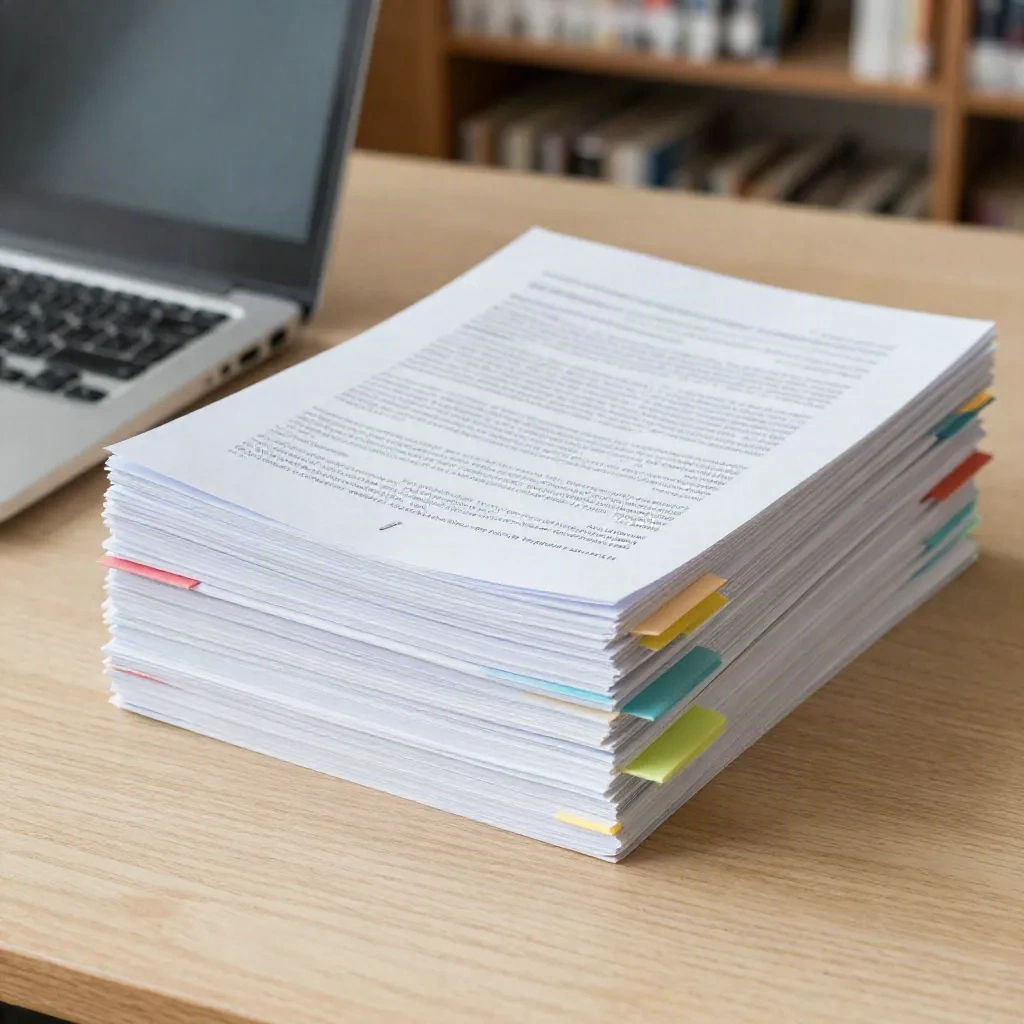
In practice, sort what is on your desk into three piles. The first pile is for sources you only need to place in the literature: the abstract and conclusion are enough. The second is for sources you will cite for one claim: find the claim, read the surrounding section, and check the method. The third is the small set that the whole project rests on, and those you read slowly, with a pencil, and more than once.
Highlighting is choosing, and choosing is understanding. Highlighting is a decision, and a page that is entirely yellow records no decision at all.
How do you read faster on dense, unfamiliar material?
You do not, at first. Unfamiliar fields are slow because every second term is new, and the fastest fix is to read one good overview before the primary papers. A review article or a textbook chapter gives you the vocabulary, and the vocabulary is what speeds you up. This is the most reliable finding in the whole literature: the best predictor of reading speed is how well you know the language of the text.
When I started working with public health literature, my pace on trial reports was about half of what it was on policy documents. Three months and perhaps forty papers later, the gap had closed without any technique at all. Familiarity is a method.
A short routine helps on hard texts:
Read the abstract and the final paragraph of the discussion first.
Skip to the methods only if the result surprises you.
Read the figures and their captions before the prose around them.
Return to the introduction last, if at all.
None of this is cheating. Authors write introductions for readers who have not yet decided to care, and you have already decided.
Can audio and read-later tools help you get through more?
Yes, with a caveat about what they are for. Text-to-speech lets you cover commute time and housework, and most people can follow synthetic speech comfortably at somewhat above their reading pace. It suits articles and newsletters. It is a poor fit for equations, tables and anything you must annotate precisely.
The tools split into two families. The first treats reading as a library problem: you save, highlight, and resurface later. The second treats it as an audio problem: you convert text to voice and listen.
On the first side, Readwise Reader handles PDFs, newsletters and web articles in one inbox, with highlighting built for close reading and text-to-speech layered on top rather than as the headline feature. Its strength is that passages you mark can come back to you later.
Matter takes a lighter approach. It is a minimalist read-it-later app, mostly for iPhone and iPad, with clean typography, gesture highlighting and text-to-speech voices that many users rate as the best among read-later apps. It is a good fit if your reading is mostly long-form articles rather than academic PDFs.
For listening, Speechify is the best-known consumer option and offers playback up to 4.5x on its paid tier, which is fast enough to be a trap. Past roughly 1.5 to 2x, most listeners retain less, so treat the top speed as a feature you will rarely use. The free tier tops out at 1.5x, which is arguably the sensible ceiling anyway.
NaturalReader is older and plainer. It reads web pages, PDFs and Word documents aloud with word-level highlighting, and offers a reflowable PDF view that matters when a two-column paper would otherwise be read straight across the columns.
None of these makes you a faster reader in the strict sense. They change where reading happens, which is a different and often more useful gain.
What should you skip entirely?
Be direct with yourself about a few popular habits.
Skip the flashing-word apps. They look efficient and the evidence points the other way. If you want to read at 500 words per minute, you need the ability to look back.
Skip eye-exercise programs. Eye movements are not the limiting factor, so training them is effort spent on the wrong muscle.
Skip the daily word-count target. A goal of 50 pages a day rewards finishing, not understanding, and finishing is the one thing you can fake.
Skip rereading as comfort. Rereading everything twice feels diligent. A single careful read followed by a short written recall is better. Close the document and write down, from memory, what the source claimed and what it left unproven. Whatever you cannot write is whatever you did not read.
What does a faster reading week look like? Take a researcher with 15 sources due for a literature review. A workable week looks like this.
On Monday, preview all 15. Read abstracts and conclusions, and sort into the three piles from earlier. This takes about two hours and typically removes five or six sources from serious consideration.
On Tuesday and Wednesday, read the middle pile with a question in hand, writing one sentence per source on what it adds. Use a pacer, and stop when the question is answered.
On Thursday, read the core sources slowly. Annotate. Read the methods. Ask what would have to be true for the conclusions to fail.
On Friday, write the synthesis from your notes rather than from the papers. If you cannot, that tells you which source needs another read.
The total reading time drops, but the more important change is that attention goes where it belongs. The problem is not the quantity. It is the sorting. A faster reader is mostly someone who has stopped giving every page the same attention.
Should you train your speed or change your habits?
Do both, in that order of effort: ninety percent habits, ten percent speed. Preview first, read with a question, match your pace to the purpose, and let vocabulary grow from reading widely in your field. Time yourself once a month on the same kind of text, and check recall every time. If the number goes up and recall holds, the method works. If the number goes up and recall drops, you have simply learned to skim, which is useful, but should be called by its name.
The question worth leaving open: of everything on your list this week, how much would you still read if you had to explain it to a colleague on Friday?