How Does AI Transcription Work? The Technical Breakdown
Summary
AI transcription converts audio to phonemes via an acoustic model, then resolves those phonemes into probable words using a language model. Speaker diarization runs in parallel to label who spoke when. Published accuracy figures -- often below 5% WER -- apply to clean single-speaker audio; real-world meetings run significantly higher. For researchers, the critical variables are custom vocabulary support, audio quality, and export flexibility, not raw benchmark scores.
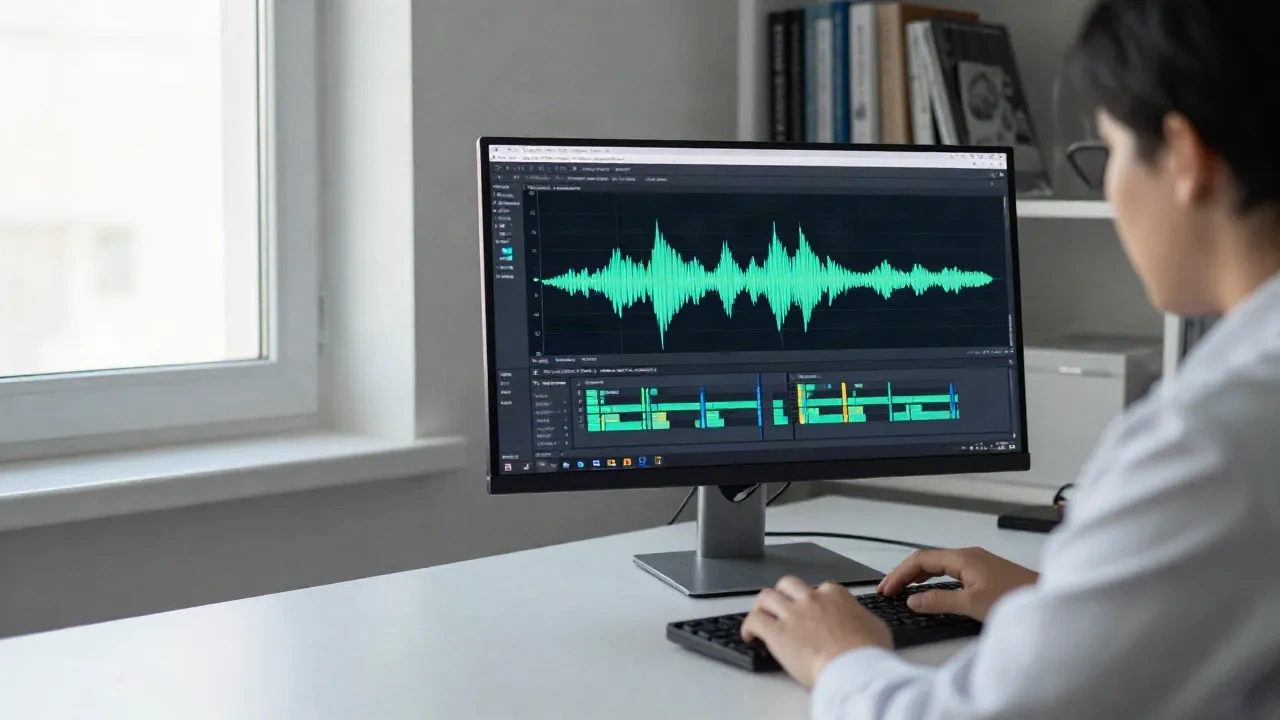
How does AI transcription work? It runs audio through two stacked systems: an acoustic model that maps sound waves to phonemes, and a language model that resolves those phoneme sequences into probable words. Output quality depends almost entirely on the cleanliness of the audio and the size of the training corpus behind those models. Word error rates below 5% are achievable on clean single-speaker recordings; expect 15-25% degradation in a six-person meeting with background noise.
The problem is not that the technology is new. Automated speech recognition has existed since the 1970s. The problem is that until transformer-based models became standard around 2022, systems processed audio sequentially, one frame at a time, without access to wider sentence context. That constraint produced transcripts riddled with homophones and missed technical terms -- recognizable to anyone who has tried to use voice-to-text for academic work before that shift. The improvement since then is real; it is also more bounded than vendor marketing suggests.
Speech is harder to parse than it looks
Printed text arrives at a reader already segmented: spaces between words, punctuation at phrase boundaries, capital letters at sentence starts. Spoken language carries none of those signals. A continuous stream of acoustic information must be sliced into meaningful units before any downstream processing can begin.
Consider what happens when a speaker says "recognize speech" at normal conversational pace. The acoustic signal between the two words contains no silence, no gap, no separator. The listener -- human or model -- must infer the boundary from probabilistic cues: duration of the final consonant, pitch movement, knowledge of likely word sequences in context. For common phrases, this works reliably. For novel technical terms, proper nouns, or domain-specific vocabulary the model has not encountered during training, boundary errors compound into transcription errors.
The irreducible difficulty of speech parsing is not a product flaw to be patched. It is a property of spoken language. Understanding that constraint is the starting point for setting sensible expectations about any transcription tool.
The acoustic model: from waveform to phoneme
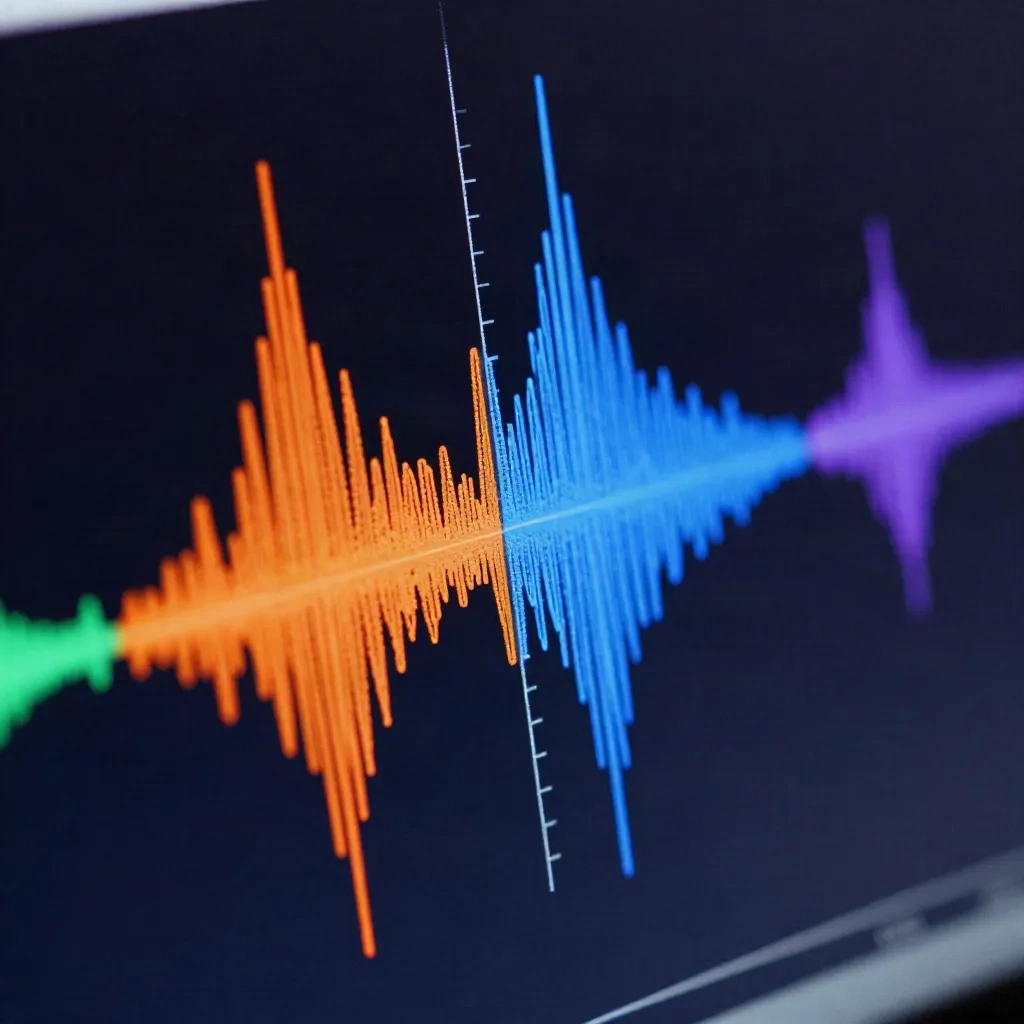
The acoustic model handles the first conversion: raw audio signal into a sequence of phonemes, the smallest perceptible units of sound. The system does not listen to words. It reads spectrograms -- two-dimensional representations of audio where one axis is time and the other is frequency. A trained neural network scans these spectrograms and assigns probabilities to phoneme sequences.
Three factors govern acoustic model performance in practice:
Sample rate and bit depth: lower-quality audio clips the frequency information the model was trained on, introducing gaps in the spectral representation
Signal-to-noise ratio: background noise introduces competing phoneme candidates the model must suppress; open-plan offices are particularly hostile environments
Speaker variation: accent, pace, and articulation shift spectrograms away from the model's training distribution, reducing confidence in phoneme assignments
The output of the acoustic model is not words. It is a probabilistic phoneme lattice -- a weighted graph of possible sound sequences -- that the next layer has to interpret. This distinction matters because errors introduced at the acoustic stage compound downstream. A misread phoneme does not always produce a plausible-sounding wrong word; sometimes it produces incoherence that later correction cannot easily reconstruct.
Language models: where context replaces guessing
The language model receives the phoneme sequence and resolves it into text by asking: given everything available in this sentence so far, what word is most probable here? This is the layer where the shift from statistical methods to transformers made a measurable difference in 2022 and after.
Older systems computed word probability from the two or three preceding tokens. Transformer-based language models attend to the entire available context window -- a full paragraph or more in current implementations. The practical consequence is correct disambiguation of homophones ("their" vs. "there"), more reliable punctuation insertion, and better recovery from short acoustic failures where context fills in what the audio missed.
What this does not solve is domain vocabulary. A model trained on general English audio assigns low probability to "probit regression" or "grey literature synthesis" -- terms a social science researcher uses routinely. Tools that allow custom vocabulary upload, or that have been fine-tuned on academic or legal corpora, reduce this gap. Evaluate that capability specifically if your work involves specialized terminology. A tool that achieves 97% WER on everyday English and 82% on your actual corpus is effectively an 82% tool for your purposes.

Speaker diarization: the step that actually matters in practice
Transcription tells you what was said. Diarization tells you who said it. The two processes run in parallel in most modern tools, but they are technically separate systems with separate failure modes -- and diarization tends to fail in exactly the situations where it matters most.
Diarization clusters audio segments by speaker identity without knowing who those speakers are. The output is labeled text: "Speaker 1:", "Speaker 2:". The tool does not know these are Lena and Marcus; that mapping requires either a voice profile database or a manual edit pass. For a two-person interview conducted with a decent microphone and clear speaker separation, this works well enough to skip most correction. For a twelve-person editorial meeting with overlapping speech, the transcript will need significant reconstruction.
Common diarization failure scenarios:
Two voices at similar fundamental frequency, particularly same-gender pairs speaking in similar registers
Overlapping speech: the system assigns each segment to a single speaker, which means the other voice in the overlap is simply dropped
Variable background noise that corrupts the speaker embedding between segments, causing the model to split one person into two apparent speakers
The problem is not the volume of the meeting -- it is separation. A well-positioned set of individual microphones will do more for diarization quality than upgrading to a premium transcription service.
Published accuracy vs. what you observe in a noisy room
The benchmark figure you encounter most often in tool documentation is a word error rate (WER) below 5% for English. WER counts substitutions, insertions, and deletions against a reference transcript: a score of 5% means five words in every hundred are wrong. What those figures rarely specify is the recording conditions under which they were measured.
Lab-condition benchmarks use clean audio from a single speaker at 16kHz, with no background noise, in the model's dominant training language. Real-world recordings from open-plan offices, video calls with inconsistent bandwidth, or field interviews captured on a smartphone against ambient sound routinely produce WER in the 15-30% range from the same model. The gap between the published figure and the observed figure is not a product defect -- it is a consequence of deploying a system outside its training distribution.

Two observations worth holding onto:
First, recording environment quality accounts for more variance than vendor choice. A quiet room and a basic USB condenser microphone will reduce your correction workload more reliably than switching between the top-tier tools. The investment in setup pays better returns than the subscription upgrade.
Second, non-English languages trail substantially. Spanish, French, German, and Mandarin are reasonably covered in the major models. Languages with smaller training corpora -- many African languages, regional Arabic varieties, smaller European languages -- produce outputs that function as rough drafts at best. If your corpus is in one of those languages, verify accuracy on a sample before committing any workflow to a tool.
Where AI transcription earns its place -- and where the gap remains
Worth stating directly on both sides.
The situations where AI transcription performs well enough to build into a workflow:
Lecture and conference recording: single dominant speaker, controlled acoustic setting, correction acceptable after the fact
Two-person qualitative research interviews: consistent speaker separation, recoverable diarization, specialized vocabulary manageable via glossary upload
Meeting summaries and action item extraction: speed of output justifies the accuracy tradeoffs at this use level
Accessibility captions: near-accuracy is sufficient for real-time captioning where context aids comprehension
The situations where the gap remains measurable and human review is not optional:
Legal and medical documentation: error rates on specialized terminology remain above professional standards; a misread term changes meaning in ways correction may not catch
Heavily accented speech outside the training distribution: the model produces plausible-sounding wrong words that require domain knowledge to identify
Multi-party roundtables with overlapping speech: the transcript often needs reconstruction rather than correction
What to evaluate before committing to a transcription tool
WER is a starting point, not the deciding variable. Here is what the benchmark does not capture for research and knowledge work:
Custom vocabulary support: academic and professional fields generate terminology continuously. A tool that accepts a glossary of domain terms and proper nouns will outperform a nominally higher-accuracy general model on your specific corpus. Ask vendors whether this is available and at which plan tier.
Export format flexibility: a transcript stored only inside a vendor's platform creates a dependency that compounds over time. Prefer tools with clean export to plain text, SRT, or structured JSON that integrates with your existing annotation or analysis workflow.
Data handling and retention policy: if you work with sensitive interview sources, unpublished findings, or protected participant data, establish how long the vendor retains your audio and transcript files, in what jurisdiction, and under what legal framework. This is not a secondary question.
Batch processing capacity: for anyone with a backlog of recordings, the ability to queue multiple files and process overnight is a workflow prerequisite, not a convenience feature.
At the end of the evaluation, what you are choosing is accuracy on your material, in your language, against your workflow constraints -- not accuracy in the abstract. The only reliable method for establishing that is a structured test on a representative sample of your own corpus before committing.